Wednesday, 2 October 2013

Innovation Jockeys Inspiration

Students on a mission to save India's Mothers

Innovation Jockeys Inspiration

“One of our team members’ sister suffered through two miscarriages. When she got pregnant a third time, Dr. Shital Munde ensured she received round-the-clock medical care and kept track with daily reports. This time, the pregnancy was a success,” recounts Shantanu Pathak, a member of Team CareMother.  

From left to right: Swapnil, Shantanu, Vaibhav and Dr Shital Somani

While they had managed to save a family member’s life through intensive medical care, Shantanu, a Telecommunications Engineer couldn’t help thinking of the women who had no access to even primary health care. What happened to them?

The research that followed threw up some shocking statistics. According to the WHO, 800 women die every day in India from preventable causes related to pregnancy and child birth. The yearly count of pregnant women in India is 30 million; with 75% of them belong to the rural areas of the country. Proper medical attention and healthcare is inaccessible in most of these areas leading to the high mortality rate. This was unforgivable. What good were the advances in modern medicine when they couldn’t reach those who required it the most? Maybe further advances needed to be made.
There was need to develop a system that would be easily accessible for women across the country to receive appropriate medical care and diagnosis during their pregnancy. The aim was to ‘educate pregnant women, empower health workers with advance tool and enable doctors to track records of all patients at one place’. If they were to deliver on all of these goals the solution required varied areas of expertise. Thus, apart from Dr. Shital Munde and Shantanu the effort brought together an interdisciplinary team from Mumbai consisting of a Polymer Engineer Swapnil Kokate, Vaibhav Tidke a Chemical Engineer, Dr Shital Somani a Dentist and Aditya Kulkarni a Computer Engineer.

The endeavor gave birth to an innovation the team calls CareMother. The innovation consists of a portable kit of sensors integrated with a mobile application for pregnancy (high risk and regular) care which can be integrated with public hospitals, government healthcare databases and even Aadhar Card ID systems.

“It allows basic, non-invasive medical test at home with unique kit and mobile application, enable doctor to track and analyse patient with historical data, connect doctor and patient 24X7 by mobile app, early diagnosis of high risk complications,” explains Vaibhav.
The team is determined that their innovation will empower gynecologists, government and health workers to reach and manage many patients and offer them quality of service.

“Over five years, CareMother will reach 15000 rural health centres and 15 million women in India by saving millions of lives, creating digital pregnancy care awareness and government money with 15 extra visits at home,” they tell us.

Apart from winning the Public Service category at Innovation Jockeys 2013, CareMother has won numerous accolades in the country and overseas as well. Chief amongst these, is being named among the top 10 innovations for Silicon Valley Programme by DST-Lockheed Martin Corp jointly with Stanford University and University of Texas, Austin, USA.

So what is their innovation mantra?

“Find the problem and convert it to an opportunity,” says Dr. Shital Munde.

Source:
http://in.specials.yahoo.com/news/students-to-the-rescue-of-india-s-mother-075730699.html

Friday, 27 September 2013

Engineer wins Shanti Swarup Bhatnagar Award for creating synthetic bone

Engineer wins Shanti Swarup Bhatnagar Award for creating synthetic bone
There is a new bone in contention only it is a synthetic one.

This synthetic bone is the work of Bikramjit Basu, a 40-year-old scientist who studied metallurgy (now called materials science) and is one of the eight recipients of India's very own Nobel Prize for young scientists-the Shanti Swarup Bhatnagar Awards, 2013.

He has won the award in 'engineering sciences' but his research promises to take care of the common man's health woes. In a country where 50 per cent of the population faces risk of some sort of bone disease, Basu has come up with a lab-grown bone.
Bikramjit Basu is a 40-year-old scientist who studied metallurgy.

That's the way of 21st century science, where cutting-edge research in biosciences is happening through engineers, physicists and chemists. "That's because, we ask different questions and pursue different methods, that biologists do not ask or are not interested in," says Basu, associate professor of materials research center at the Indian Institute of Science, Bangalore.

New research in the medical sciences is also marked by a materials rush. Biomaterials, from nature or grown in the lab, are substances that are being 'mashed' with biological systems, supplementing or replacing natural functions. The 50-year-old science has grown so much that the materials are now being used every day in surgical procedures and drug delivery.

"Natural bone consists of collagen and something called hydroxyapatite," says Basu. Collagen is a protein that gives bone its resilience, while hydroxyapatite-the source of bone calcium-provides strength and rigidity. For the last four-five years, Basu and his team-first at IIT-Kanpur and then at IISc-has been working on developing an 'implantable biomaterial' that would regenerate bones. "We needed to create something that would have electrical property, biological compatibility, strength and toughness to resist fractures."

His engineering skills came into play: measuring a material's ability to conduct electric current is essentially an engineer's approach. But the problem in hand was fundamentally biological: "Cells in the body communicate with each other by sending and receiving signals," he adds. Signals, from outside the body or from other cells, are passed on though electrical impulse. In a unique experiment in his lab Basu showed that when electrical current was sent in, his bone implants allowed cells to "crosstalk" and grow.


The science has enormous healthcare implications. It simply means better treatment and healing for bone injuries: it can be fixed onto bones, be shaped to fit voids or chips, be absorbed by the body eventually to re-grow new bones.

Question is: when will it reach the common man? "For lab-grown systems to work in the body, there are many more steps that need to be taken, including clinical trials," he says. For that clinicians and engineers need to work very closely. "But in our country such work rarely takes place. Everybody works in isolation. And scientific research does not get translated into application." This is where the West beats the developing world. During his research at University of Leuven in Belgium as well as University of California, Santa Barbara, US, this is what he saw: "Most top universities have a hospital and a host of research labs work in collaboration with it. The work gets translated seamlessly, from lab bench-side to hospital bedside."

For now, such awards bring visibility to the field and to our world-class researchers. For Basu's father, who could never pursue his academic dreams and worked in the railways to hold his family together in the wake of Partition, this is a dream come true. The nation, however, has to walk many more miles before the synergy of science and clinical application can join hands to reach the common man.
Source:

Monday, 16 September 2013

Egg vendor gives free coaching to civil services aspirants in Bihar


'Egg vendor' gives free coaching to civil services aspirants in Bihar


Manoj Kumar Roy, now an Indian Ordnance Factory Service officer, sold eggs, worked as a vegetable vendor and even mopped the floors of an office to earn a living during his struggling days.
He sold eggs, worked as a vegetable vendor and even mopped the floors of an office to earn a living during his struggling days in Delhi. Sheer grit and hard work only helped Manoj Kumar Roy, who hails from Bihar, brave all odds and bag the 870th rank in the coveted central services exam in 2010.

Roy (35) - now an Indian Ordnance Factory Service (IOFS) officer - spends his weekends grooming poor students of his state to help them crack the UPSC exam.

"The service is absolutely free," he said.

Roy travels 110km from Nalanda, where he is posted as an administrative officer at Rajgir Ordnance factory, to Patna every weekend.

"When I cracked the civil services in my fourth attempt, I thought about many youngsters who could not afford the costly coaching," he said. "So I decided to extend my help to them." Roy said he was lucky to get his first posting at Rajgir in his home state. "I was allotted the IOFS on the basis of my rank in the UPSC exam," he said.

Roy started providing free coaching to deserving and poor children soon after he was posted at Rajgir. "Most of my students belong to poor or lower middle class families," he said.


 Manoj Kumar Roy with one of his students, Reshu Krishna, who came 13th in BPSC exam.

Roy's mission is supported by his wife Anupama Kumari, a deputy collector in Patna City. "My wife has qualified the Bihar Public Service Examination," he said. "I asked her to coach and share her experiences with my students. She readily agreed to my request." Most of his successful students owe their success to Roy. Reshu Krishna, who scored the 13th rank in the BPSC examination and qualified for the post of deputy superintendent of police, said she had benefited immensely from Roy's classes.

"Sir (Roy) used to teach us geography and general studies," she said. "His tips were invaluable to all of us." Arun Kumar, who came 390th in the same examination, said Roy inspired him to appear for the BPSC exam. "I came in contact with Roy sir during my college days," he said. "When I failed to qualify in the UPSC examination and the Bihar Police's recruitment test for sub-inspectors, Roy sir motivated me and helped me crack the state civil services examination," Arun said.

As many as 45 students, who were trained by Roy, have qualified the recent combined BPSC exam of three batches.


Source:
http://indiatoday.intoday.in/story/egg-vendor-free-coaching-to-bihar-students-upsc-exam-patna/1/309994.html

Friday, 30 August 2013

Engineer's plastic-to-fuel device passes patent office tests


Engineer's plastic-to-fuel device passes patent office tests

CHENNAI: Is necessity the mother of invention? Well, not always. Determined to find a cheap and sustainable fuel, engineer Chitra Thiyagarajan developed a unit that converts plastic waste into a fuel similar to diesel. After a series of tests in a sustained three-year effort, Thiyagarajan finally perfected the device and applied for a patent.


Machine converting plastic to fuel


 C S M Sundaram, Thiyagarajan's guide, said the device was the result of backbreaking work, persistence and dogged tenacity. "It involved research, fieldwork and frequent upgrading of design," he said. "I may have helped her occasionally but the credit is all hers," said Sundaram, 80, a retired professor of St Xavier's College, Mumbai.
She applied for a patent for the device in June 2013. "The patent authorities checked the machine for two months and verified that it could be patented. They accepted my application in August," Thiyagarajan said.

Explaining how her 'pyro-plant' functions, she said, all plastics except PET bottles are put in a chamber and heated in the absence of oxygen over chromium micro band heaters (similar to those used in water immersion rods) to temperatures of between 350oC and 375oC. The gas generated passes into another chamber with a water coolants coils on two sides. It is then pumped into another compartment half-filled with water. The fuel floats on the surface. Non-soluble gas that passes into a condenser can be used as an LPG alternative.
The device is not expensive and requires just three hours to generate fuel. A 5kg unit costs around Rs 75,000 and a 25kg variant, Rs3 lakh. Each kg of plastic produces 800ml of diesel. While the diesel can be stored, the LPG generated has to be used directly and cannot be compressed, Thiyagarajan said.

"A similar process is used to generate fuel in China but the production costs are high and it is a time-consuming process," Thiyagarajan said.
Indian Institute of Technology-Madras chemical engineering professor S Pushpavanam said the invention is feasible and could be used to produce fuel.
Thiyagarajan's other inventions include a night vision camera and an electromagnetic belt for physiotherapy.

Source:
http://articles.timesofindia.indiatimes.com/2013-08-26/chennai/41454053_1_fuel-patent-device

Sunday, 25 August 2013

They can, because they think they can

They can, because they think they can
  
In spite of being visually challenged, Naqi Hyder Rizvi has topped the Industrial Engineering exam of Alfaisal University, Riyadh, while his younger sister Rubab Fatima, with partial vision, is equally capable

Mumtaz Fatima flanked by her son Naqi Hyder Razvi and daughter Rubab Fatima at The Hindu's office in Hyderabad on Wednesday. Photo: K. Ramesh Babu
Mumtaz Fatima flanked by her son Naqi Hyder Razvi and daughter Rubab Fatima at The Hindu's office in Hyderabad on Wednesday

You’ll never find a rainbow if you are looking down. And Naqi Hyder Rizvi never did. He always believed in positive anything is better than negative nothing. Today Naqi’s family is justifiably proud of his achievements. In spite of being visually challenged, Naqi (22) has topped the Industrial Engineering exam of the Alfaisal University, Riyadh, held in June.
 
Naqi and his younger sister, Rubab Fatima, are victims of congenital glaucoma. While Naqi lost vision in both eyes at the age of seven, his sibling has partial vision in the right eye while the left one is totally blind. Interestingly, both of them have never been to a school for visually-impaired.
 
Right from nursery they have studied in normal schools and excelled. Fatima (21) is now pursuing B.Sc in Saudi Arabia where her parents have settled down. The family makes an annual visit to Hyderabad for check up at L.V. Prasad Eye Hospital.

Woman of steel
Behind every successful person there is a woman. And in their case it is their mother Mumtaz Fatima. Superhuman is how they describe their mother. An MBA graduate herself, Mumtaz turned down many lucrative jobs just to help her children get a good grounding in education. Love is the language which the deaf can hear and the blind can see. The duo not just feel, but also see the motherly affection showered by Mumtaz which helped them face the challenges upfront.
 
Right from day one Mumtaz did not allow her children to get the feeling of being disabled. She treated them like normal kids and in this, she got support from her Pakistani husband Sibte Hyder Rizvi. The National Association for Blind, Mumbai, was very supportive.
Many regular schools in Karachi refused to accept the children. Luckily, Springfield School admitted them. But it was only the beginning and not the end of the struggle. A brilliant child, Naqi could easily comprehend and remember what was taught in the classroom. But his mother had to put in extra effort to help him write. “I made clay models of various things so that he can touch and feel the shape. I also made maps using cotton for him to identify,” says Mumtaz.
 
She also learnt Braille script and experimented with assistive technology like tape recorder, German plastic sheets, computer speaker software, JAWS, to help Naqi learn the lessons.
“I had very understanding and accommodating friends and faculty at the university,” says Naqi.
 
The only thing worse than being blind is having sight, but no vision. But Naqi has his plans worked out. Both he and his sister feel a strong sense of belonging for people from both sides of the border since their father is from Pakistan and mother from India.
“I want to be an ambassador of peace,” says Naqi.

Source:

http://www.thehindu.com/news/cities/Hyderabad/they-can-because-they-think-they-can/article5049600.ece?homepage=true

Tuesday, 13 August 2013

RAKHI'S BY KGNM TRUST INMATES, HYDERABAD

RAKHI'S BY KGNM TRUST INMATES, HYDERABAD

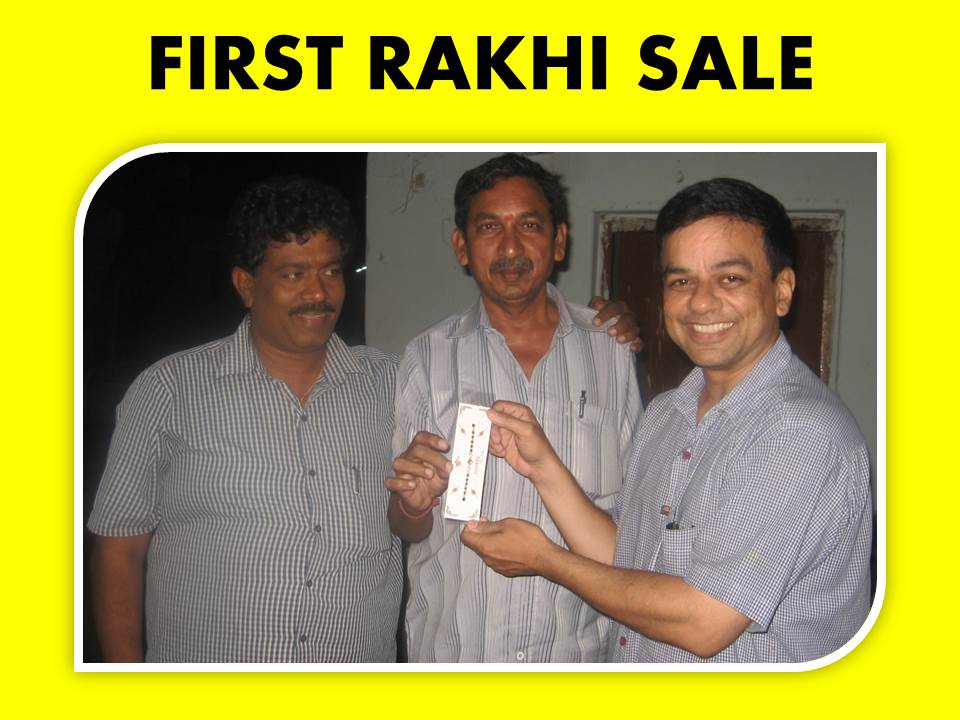
As the festive season of Rakshabandan is fast approaching, I encouraged inmates of Kasturba Gandhi National Memorial Trust (KGNMT, a house of destitute women), Hyderabad to make Rakhis. This is their first attempt to make Rakhis.  I was amazed at their commitment and interest. They made several Rakhi’s of different styles and colors.

The inmates actively participated and made Rakhis.  This activity bonded them like a glue.  Their confidence was also boosted.  They were so excited when they made their first Rakhi sale, that it was very difficult to contain their excitement.


The inmates already sold about 150 Rakhis.  The inmates are also planning some activities like diya making, greeting cards etc. for Diwali season.

The intent of these activities is to make them feel that they are also capable of making something that is useful to the society, generate some revenues and more importantly inject the dose of self-confidence and make them feel that they are also capable of developing creative artifacts.

If you have ideas as to how we can encourage and make KGNMT inmates self-reliant, send your comments to Ravi Talluri: info_rst@yahoo.com

Feel free to contact the following persons, if you want to place orders and encourage the inmates of KGNMT.

Mr. Murthy, Manager KGNMT 9347502345

Mr. Srinavas, Manager KGNMT 9393667141


Sunday, 4 August 2013

Creative Children At KGNM Trust

CREATIVE CHILDREN AT KGNMT TRUST, HYDERABAD

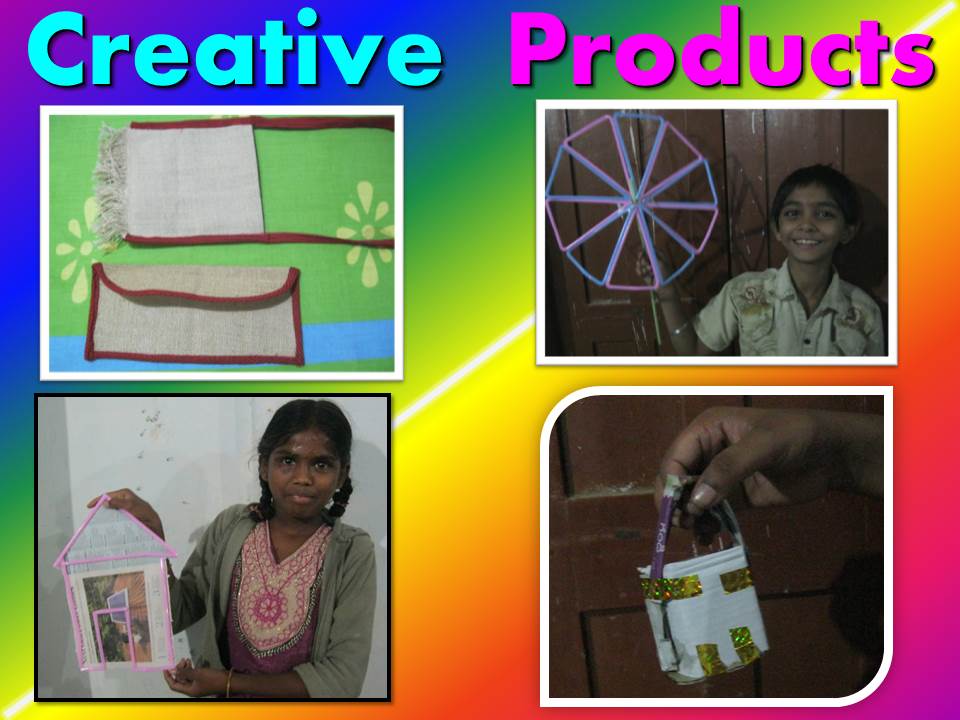
The Kasturba Gandhi National Memorial Trust (KGNMT) at Hydersha Kote, Hyderabad, AP, India is an abode for destitute women and children. The center is providing training to women in various categories of self-help skills such as Tailoring Embroidery, Textile block printing, Biscuit-making, Bakery, Confectioneries and Condiments etc.  Currently the trust has about 130 members whose age ranges from 6 months to 70 years. Of these 130 members, about 40 members are students.  These students are attending schools and colleges.

A creativity workshop was conducted for these students.  The results were very fascinating.  The members freely expressed their ideas and demonstrated their talent.  As usual, I was astonished at their creative ideas. This is a special workshop unlike other school workshops, considering the trauma and hardships of the inmates. This workshop certainly worked as a morale booster.  It boosted their subdued creative spirits and increased cohesiveness.  We have to inject the confidence required for them to join the main stream of the society.  They need support and encouragement.  The support does not necessarily mean monetary support.  They must get the feeling that their voice and ideas are heard.  They need to be encouraged and more importantly appreciated. Momentarily they forgot their agonies.  We have to make it a point and pave way to make them permanently forget their agony and past.
The journey has just begun and path is full of challenges.  With the limited resources and several constraints, the creativity workshop was successfully conducted.  Obviously one such workshop will not give us the desired results. I am planning to conduct series of such workshops at KGNMT.  The intent is two folds – boost their self-esteem and nurture their creative talent. The more we encourage them the more they are likely to make an attempt to come out of their shell.  
I would like to emphasize the fact that unlike normal kids and students, the inmates of KGNMT is growing up in very challenging circumstances.  There is a crying need to support the inmates. Please take few moments to admire their talent.  Also feel free to share your ideas on how to conduct more meaning full workshops in order to ensure that they can lead normal life over a period of time.  I want to thank KGNMT staff and others for supporting me in my endeavors.  My special thanks to friend to Mr. Jai Shankar, who sponsored the workshop. Without your support the mission will be unfinished.  I am counting on your continued support.