Friday, 30 August 2013

Engineer's plastic-to-fuel device passes patent office tests


Engineer's plastic-to-fuel device passes patent office tests

CHENNAI: Is necessity the mother of invention? Well, not always. Determined to find a cheap and sustainable fuel, engineer Chitra Thiyagarajan developed a unit that converts plastic waste into a fuel similar to diesel. After a series of tests in a sustained three-year effort, Thiyagarajan finally perfected the device and applied for a patent.


Machine converting plastic to fuel


 C S M Sundaram, Thiyagarajan's guide, said the device was the result of backbreaking work, persistence and dogged tenacity. "It involved research, fieldwork and frequent upgrading of design," he said. "I may have helped her occasionally but the credit is all hers," said Sundaram, 80, a retired professor of St Xavier's College, Mumbai.
She applied for a patent for the device in June 2013. "The patent authorities checked the machine for two months and verified that it could be patented. They accepted my application in August," Thiyagarajan said.

Explaining how her 'pyro-plant' functions, she said, all plastics except PET bottles are put in a chamber and heated in the absence of oxygen over chromium micro band heaters (similar to those used in water immersion rods) to temperatures of between 350oC and 375oC. The gas generated passes into another chamber with a water coolants coils on two sides. It is then pumped into another compartment half-filled with water. The fuel floats on the surface. Non-soluble gas that passes into a condenser can be used as an LPG alternative.
The device is not expensive and requires just three hours to generate fuel. A 5kg unit costs around Rs 75,000 and a 25kg variant, Rs3 lakh. Each kg of plastic produces 800ml of diesel. While the diesel can be stored, the LPG generated has to be used directly and cannot be compressed, Thiyagarajan said.

"A similar process is used to generate fuel in China but the production costs are high and it is a time-consuming process," Thiyagarajan said.
Indian Institute of Technology-Madras chemical engineering professor S Pushpavanam said the invention is feasible and could be used to produce fuel.
Thiyagarajan's other inventions include a night vision camera and an electromagnetic belt for physiotherapy.

Source:
http://articles.timesofindia.indiatimes.com/2013-08-26/chennai/41454053_1_fuel-patent-device

Sunday, 25 August 2013

They can, because they think they can

They can, because they think they can
  
In spite of being visually challenged, Naqi Hyder Rizvi has topped the Industrial Engineering exam of Alfaisal University, Riyadh, while his younger sister Rubab Fatima, with partial vision, is equally capable

Mumtaz Fatima flanked by her son Naqi Hyder Razvi and daughter Rubab Fatima at The Hindu's office in Hyderabad on Wednesday. Photo: K. Ramesh Babu
Mumtaz Fatima flanked by her son Naqi Hyder Razvi and daughter Rubab Fatima at The Hindu's office in Hyderabad on Wednesday

You’ll never find a rainbow if you are looking down. And Naqi Hyder Rizvi never did. He always believed in positive anything is better than negative nothing. Today Naqi’s family is justifiably proud of his achievements. In spite of being visually challenged, Naqi (22) has topped the Industrial Engineering exam of the Alfaisal University, Riyadh, held in June.
 
Naqi and his younger sister, Rubab Fatima, are victims of congenital glaucoma. While Naqi lost vision in both eyes at the age of seven, his sibling has partial vision in the right eye while the left one is totally blind. Interestingly, both of them have never been to a school for visually-impaired.
 
Right from nursery they have studied in normal schools and excelled. Fatima (21) is now pursuing B.Sc in Saudi Arabia where her parents have settled down. The family makes an annual visit to Hyderabad for check up at L.V. Prasad Eye Hospital.

Woman of steel
Behind every successful person there is a woman. And in their case it is their mother Mumtaz Fatima. Superhuman is how they describe their mother. An MBA graduate herself, Mumtaz turned down many lucrative jobs just to help her children get a good grounding in education. Love is the language which the deaf can hear and the blind can see. The duo not just feel, but also see the motherly affection showered by Mumtaz which helped them face the challenges upfront.
 
Right from day one Mumtaz did not allow her children to get the feeling of being disabled. She treated them like normal kids and in this, she got support from her Pakistani husband Sibte Hyder Rizvi. The National Association for Blind, Mumbai, was very supportive.
Many regular schools in Karachi refused to accept the children. Luckily, Springfield School admitted them. But it was only the beginning and not the end of the struggle. A brilliant child, Naqi could easily comprehend and remember what was taught in the classroom. But his mother had to put in extra effort to help him write. “I made clay models of various things so that he can touch and feel the shape. I also made maps using cotton for him to identify,” says Mumtaz.
 
She also learnt Braille script and experimented with assistive technology like tape recorder, German plastic sheets, computer speaker software, JAWS, to help Naqi learn the lessons.
“I had very understanding and accommodating friends and faculty at the university,” says Naqi.
 
The only thing worse than being blind is having sight, but no vision. But Naqi has his plans worked out. Both he and his sister feel a strong sense of belonging for people from both sides of the border since their father is from Pakistan and mother from India.
“I want to be an ambassador of peace,” says Naqi.

Source:

http://www.thehindu.com/news/cities/Hyderabad/they-can-because-they-think-they-can/article5049600.ece?homepage=true

Tuesday, 13 August 2013

RAKHI'S BY KGNM TRUST INMATES, HYDERABAD

RAKHI'S BY KGNM TRUST INMATES, HYDERABAD

As the festive season of Rakshabandan is fast approaching, I encouraged inmates of Kasturba Gandhi National Memorial Trust (KGNMT, a house of destitute women), Hyderabad to make Rakhis. This is their first attempt to make Rakhis.  I was amazed at their commitment and interest. They made several Rakhi’s of different styles and colors.

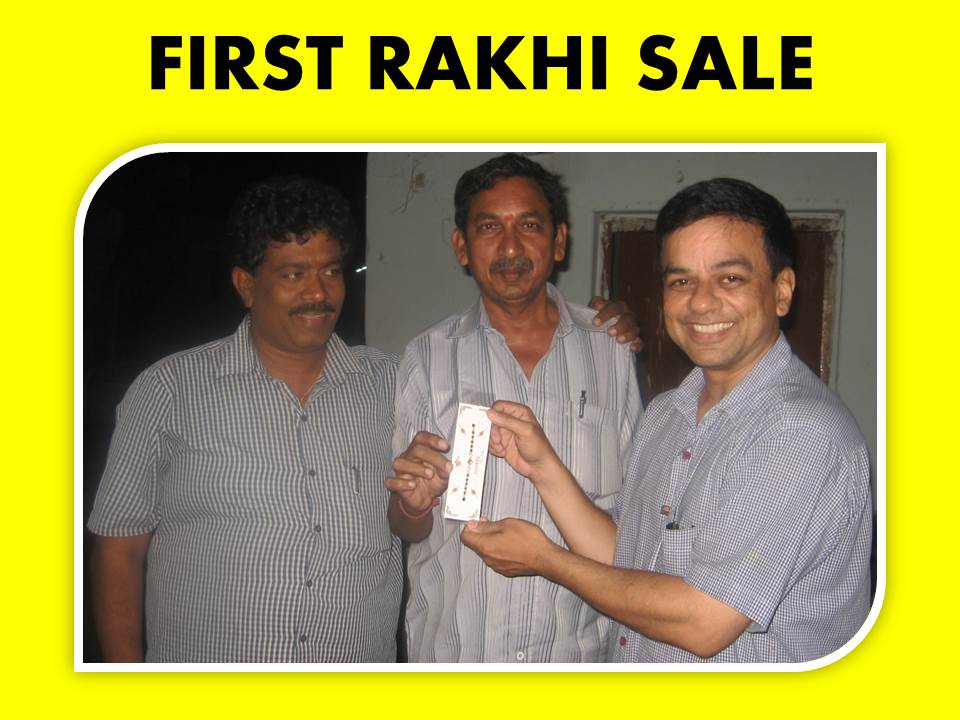
The inmates actively participated and made Rakhis.  This activity bonded them like a glue.  Their confidence was also boosted.  They were so excited when they made their first Rakhi sale, that it was very difficult to contain their excitement.


The inmates already sold about 150 Rakhis.  The inmates are also planning some activities like diya making, greeting cards etc. for Diwali season.

The intent of these activities is to make them feel that they are also capable of making something that is useful to the society, generate some revenues and more importantly inject the dose of self-confidence and make them feel that they are also capable of developing creative artifacts.

If you have ideas as to how we can encourage and make KGNMT inmates self-reliant, send your comments to Ravi Talluri: info_rst@yahoo.com

Feel free to contact the following persons, if you want to place orders and encourage the inmates of KGNMT.

Mr. Murthy, Manager KGNMT 9347502345

Mr. Srinavas, Manager KGNMT 9393667141


Sunday, 4 August 2013

Creative Children At KGNM Trust

CREATIVE CHILDREN AT KGNMT TRUST, HYDERABAD

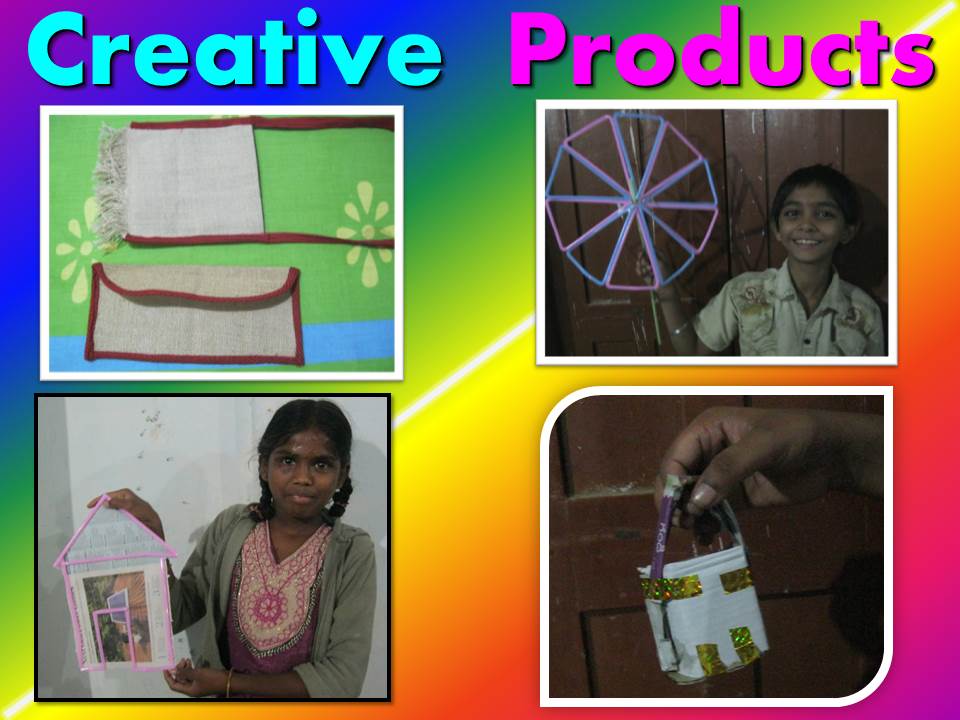
The Kasturba Gandhi National Memorial Trust (KGNMT) at Hydersha Kote, Hyderabad, AP, India is an abode for destitute women and children. The center is providing training to women in various categories of self-help skills such as Tailoring Embroidery, Textile block printing, Biscuit-making, Bakery, Confectioneries and Condiments etc.  Currently the trust has about 130 members whose age ranges from 6 months to 70 years. Of these 130 members, about 40 members are students.  These students are attending schools and colleges.

A creativity workshop was conducted for these students.  The results were very fascinating.  The members freely expressed their ideas and demonstrated their talent.  As usual, I was astonished at their creative ideas. This is a special workshop unlike other school workshops, considering the trauma and hardships of the inmates. This workshop certainly worked as a morale booster.  It boosted their subdued creative spirits and increased cohesiveness.  We have to inject the confidence required for them to join the main stream of the society.  They need support and encouragement.  The support does not necessarily mean monetary support.  They must get the feeling that their voice and ideas are heard.  They need to be encouraged and more importantly appreciated. Momentarily they forgot their agonies.  We have to make it a point and pave way to make them permanently forget their agony and past.
The journey has just begun and path is full of challenges.  With the limited resources and several constraints, the creativity workshop was successfully conducted.  Obviously one such workshop will not give us the desired results. I am planning to conduct series of such workshops at KGNMT.  The intent is two folds – boost their self-esteem and nurture their creative talent. The more we encourage them the more they are likely to make an attempt to come out of their shell.  
I would like to emphasize the fact that unlike normal kids and students, the inmates of KGNMT is growing up in very challenging circumstances.  There is a crying need to support the inmates. Please take few moments to admire their talent.  Also feel free to share your ideas on how to conduct more meaning full workshops in order to ensure that they can lead normal life over a period of time.  I want to thank KGNMT staff and others for supporting me in my endeavors.  My special thanks to friend to Mr. Jai Shankar, who sponsored the workshop. Without your support the mission will be unfinished.  I am counting on your continued support.


Wednesday, 31 July 2013

Chennai youngster invents hybrid eco-friendly cab


To tackle the ever growing menace of rising fuel price and risk of pollution, Shivaraj Muthuraman has invented a cab that runs on solar energy and electrical charging. The cab will be launched on August 14, 2013.


To watch video visit:


Sunday, 28 July 2013

 
In May this year, 19 year old Diwank Singh Tomer joined 19 other young and exceptional youngsters from around the world to become a Thiel Fellow. The Thiel foundation’s fellowship comes with a $100,000 cheque and access to some of the greatest mentors of our times not least of whom is the legendary Peter Thiel - PayPal co-founder and Facebook's first investor.
 
Tomer is now working on a platform to create interactive lessons in basic sciences in the mecca of technology– the Silicon Valley. It isn’t often that a youngster–schooled in the hills of Mussoorie  and a college dropout– makes it that far at 19. Tomer’s journey is both fascinating and inspiring.   It all started when he was eight when his mother took him to a summer coding camp.  "I also turned out to be pretty good at it and had a small article about me in the local newspapers when I was 8,” says Tomer, who was hailed as an “exceptional hacker,” by the Thiel foundation. 
 
Born in small town India, he was sent to boarding schools by parents who wanted him to get better education. In 10th standard, he scored 98% marks, studying at the Wynberg Allen School.  “I really picked up a good hold on spoken English there as well,” says Tomer, who completed high school in Delhi Public School in R K Puram, New Delhi. This is where he really started to learn coding. 

After school, he joined a premier engineering college in Goa and dropped out in just a month, last September.  “It was probably the most rewarding (and the most frightening) decision of my life and I don’t regret it at all,” he said and hastens to add that he has nothing against the institute.  “Just that, spending 4 years of my life getting a degree rather than working on things that I am passionate about seem like a poor investment of my time.” Dropping out of college to become an entrepreneur has been an incredibly exciting and humbling experience for him because of his love for building things. 

Tomer is the first technology entrepreneur in his family so it took some time to explain what he was up to, but his family has been supportive of his journey.  “The worst case scenario would have been that I failed, learned quite a bit and went back to college,” he said. After dropping out, he flew to the bay area where he met like minded people.  “Dropping out is definitely a bit more acceptable here (US) exponentially more so in the Silicon Valley where it’s even encouraged to some extent,” he says. In the US, he adds, that many schools have options to take a gap year or rejoining college within a few years. 

In the months to come, he has plans to prototype his idea, hire a team and raise funds to support his venture.

Source:
http://in.specials.yahoo.com/news/another-teen-genius-drops-out-of-college-to-make-it-big-082006756.html


Wednesday, 24 July 2013

Creativity at Gowdavalli ZP Government High School


CREATIVITY AT GOWDAVALLI ZP GOVERNMENT HIGH SCHOOL

6th, 7th, 9th and 10th class students of Gowdavalli Zilla Parishat Government High School, about 45 KM from Hyderabad, swung into action the minute I walked into the class room to conduct creativity workshop.

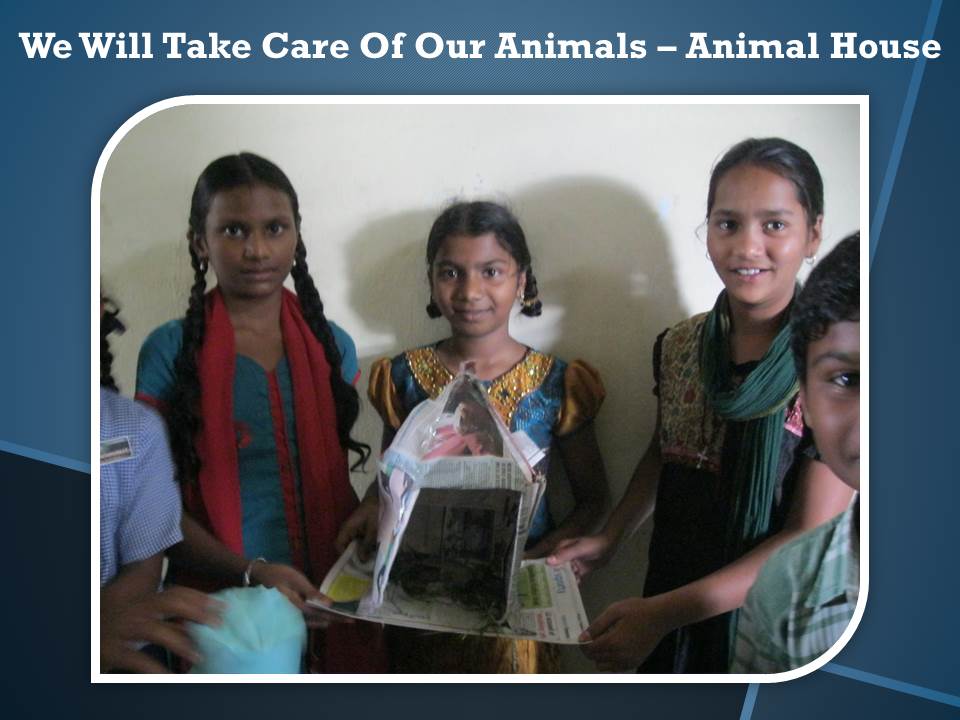
Young minds were beaming with enthusiasm and were just waiting for my instructions.  The students got newspapers, straws, tape, scissors, thread etc. for the workshop.  I suggested building a water tank or a college building.  Some students came up with their own plans.  They wanted to build park, parrot cage, temple, a small town, etc.  I encouraged them to think independently and go ahead with their plans.

They were really engrossed in the entire workshop.  The teachers were very supportive.  I was really amazed at the imaginary and creative skills of the students.  Though some of the groups were short of material, they all managed to outsmart each other and came up with unique and creative concepts.  They managed to do it in the allotted time and with the limited resources and material.  A student presented me a greeting card made up of pulses.  To me it was a gold medal presented by a future innovator of India.

These students proved that they are second to none when it comes to creativity and innovation.  I requested the principal and the teachers to encourage the students.  I suggested them to present some of the challenges confronting the village and let the students come up with creative ideas to solve the problems.  You never know how these young minds from rural areas will amaze the entire world.  They need to be encouraged.  They are our future.  They have to be carefully nurtured. Some of them will surprise the world with the creativity and innovation. Unfortunately I have limited bandwidth to take up more such activities.  I will do my best; though I know what I am doing is not sufficient.  My quest will continue. There are many individuals who are encouraging creativity in government run schools.  It has to spread across the country and it has to be sustained on a continual basis.

Please take few moments and admire the creativity of the Gowdavalli ZP Government School children.