Wednesday, 14 June 2017

These easy to assemble toilets developed by CSIR will be a boon to areas without toilets


These easy to assemble toilets developed by CSIR will be a boon to areas without toilets
Chennai's CSIR-SERC came up with an easy to assemble toilet that could solve all the problems regarding lack of toilets in the interior regions of India.
 (Representational image)
The Council for Scientific and Industrial Research and Structural Engineering Research Centre (CSIR-SERC) in Chennai has come up with an easy to assemble toilet that could reach interiors of India where there are a severe lack of toilets.
More about the easy to assemble toilets:
·       The toilet can be assembled in less than 5 hours
·       It will weigh less than 500kg
·       The toilet is made with a textile reinforced concrete (TRC) panels developed by CSIR
·       The life span of the toilet would be around 25-30 years
·       These sheets vary in thickness from 15mm to 25mm and there is absolutely no need for moulds in order to prepare these sheets
·       These sheets are corrosion free and are able to hold in rough winds; so, these sheets will withstand every kind of weather
·       For now, each toilet costs between Rs 12,000 and Rs.15,000. With buildtex-the textile used in building applications--being manufactured in India, the cost is expected to come down.
As reported by The Hindu, on Saturday a memorandum of understanding was signed between CSIR-SERC and Smart Build Prefab Pvt. Ltd, Hyderabad for the transfer of manufacturing TRC panels required for the construction of such toilets.
The TRC panels can also be used as flooring, roofs, doors, walls, etc. The sheets are reinforced using a glass textile mesh along with a grained cementious binder. It was in 2014 that the CSIR-SERC applied for a patent for this versatile piece of technology.
This memorandum is said to have been signed during the foundation day programme of CSIR-SERC, which was presided over by Santosh Kapuriya, Director, CSIR-SERC.
About CSIR:
CSIR is an autonomous body and India's premiere research and development (R&D) organisation. Its other activities include research in structural engineering, life sciences, chemicals, aerospace engineering, ocean sciences, mining, leather, food, petroleum and environment.The CSIR laboratories have achieved expertise in structural components, design and testing of structure and analysis. It's primarily funded by the Union Ministry of Science and Technology. The services are sought by the union, state as well as public and private sector undertakings.
 
Source:


Saturday, 3 June 2017

How 5 IIT graduates are changing the way slum kids play


How 5 IIT graduates are changing the way slum kids play


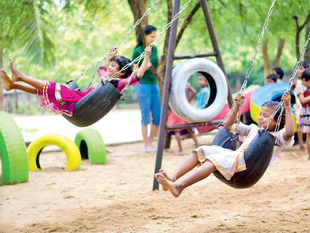
Swings made from old car tubes
 

By: Vidya DeshPande

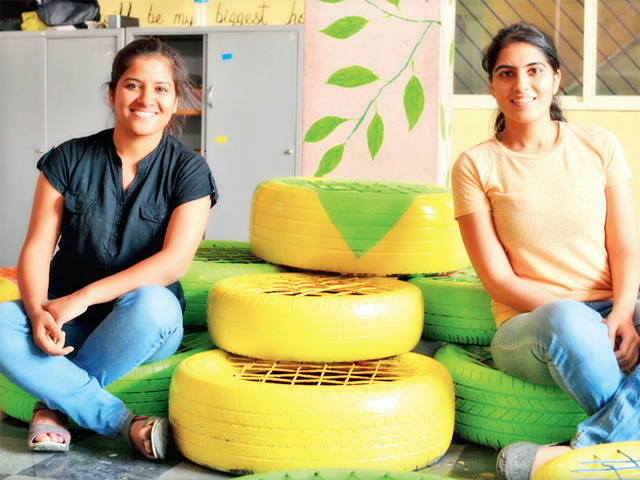
Get five architecture students from IIT together. Throw in some used tyres and what do you get? The most colourful play zones for underprivileged kids. That's exactly what Pooja Rai, Nancy, Nupur Agarwal, Vishesh Gupta and Souradeep Paul from the 2015 batch, IITKharagpur do, with their company, Anthill Creations.

The five batchmates decided to put their architectural training to good use by building slides, swings, jungle gyms for kids who don't have access to proper play zones. What started as a college project has now turned into a full-time passion. In fact, two of them, Pooja and Nancy, have quit their jobs and are devoting all their time to setting up these play spaces.

Power Play
They chanced upon this idea of recycling tyres while one of them was on a college internship in Morocco.

The architect they were interning with was passionate about recycling non-biodegradable materials and using them in buildings. They decided to use this as the main theme for their playground projects. Their first project was on their college campus, the Disha Seema Care Center, a school for children from villages around the IIT-Kharagpur campus.


They got tyre company Michelin to help them with the funding and set up a colourful playground that became the talk of the town. "We all started working in our fulltime jobs, but my passion was to build these playgrounds," says Pooja Rai, cofounder and CEO at Anthill Creations. "We set up the company in Bengaluru after we graduated but, last December, Nancy and I decided to quit our jobs and devote all our time to fulfill this passion," she says. The other three are part-time directors and help with projects in Delhi, where they are based. Nancy is the company's chief operating officer, while the other three function as parttime directors.

Their first project was in a Bengaluru slum area, where they built a small playground. "The whole setup cost us about `20,000 and was finished in just five days," says Pooja. Inspired by the success of this play zone, they tied up with a local non-profit, Mantra4Change, and set up an innovative library using recycled tires for chairs and tables at the Florida English School in Goripalya, which caters to children from slum areas.

Another volunteer group, Storytime, ran a campaign in Bengaluru and got books for this library for 850 students. Since then they have done eight other projects in Pune, Delhi, Auroville and Nizamabad.


But now they have hit the financial hurdle. "While we have some projects in hand, we are finding it difficult to find funding," says Pooja. Why haven't they approached tyre companies to help them out? "Most tyre companies have waste/old tyres in their factories and it costs us to transport them to our site. We find it easier to source the tyres from scrap and tyre dealers locally," she explains.


Anthill Creations is looking for a way to monetise the projects better. They are trying to contact private builders and set up play areas in their condominium projects. The plan is to use the money they make from these private projects to fund the playgrounds for underprivileged kids.


"We want to scale up by doing 100 projects in the next six months," says Pooja. Anthill is also talking to central and state governments to set up cost effective, eco-friendly play areas in government schools. It isn't proving easy. "Somehow, we have not been able to get access to the government and have been finding it difficult to explain our process to them," says Pooja. But these charged youngsters don't want to wait for collaborations. "We will continue building projects and are willing to form collaborations as we move on."

Anthill also wants to revitalise public spaces not only for kids but also for the whole community to use. "Unused spaces, streetscapes, parks, public plazas can become hubs for community interactions, if properly planned," says their mission statement. Congestion, traffic, has overrun most public spaces and the green zones have got eaten up by pollution and over population, explains Pooja. By reclaiming these spaces and building them with recycled materials, Anthill wants to create sustainable and long-lasting solutions.


There's no doubt that their playgrounds have become a big hit. "Our biggest testimony: the smiles on kids' faces when they have fun on Anthill's colourful tyre swings, tyre tunnels, and tyre slides," grins Pooja.


Source:
http://economictimes.indiatimes.com/news/politics-and-nation/how-5-iit-graduates-are-changing-the-way-slum-kids-play/articleshow/

Friday, 5 May 2017

Sam Pitroda’s varsity to launch low-cost water purifier


Sam Pitroda’s varsity to launch low-cost water purifier
BENGALURU: City-based Trans Disciplinary University (TDU), the brainchild of technocrat Sam Pitroda, will launch a simple copper-based water purification device called TamRas, which costs a fraction of the price of reverse osmosis units available in the market.

TamRas is the university’s first commercial product developed after successful field tests in seven villages in Karnataka and two sites in Kenya.
The university claims that pathogens causing diarrhea get killed once water is stored in the copper-based unit for
8-10 hours.

“The ancient practice of storing drinking water in copper vessels is mentioned in ancient Ayurveda texts. Our first successful experiment was by storing contaminated water in copper pots. Since copper vessels are expensive, we have come up this innovation that does not require any electricity or fuel,” said Padma Venkat, professor and advisor at TDU School of Life Sciences. “There is huge potential for this product because diarrhea is the second-largest killer of children below the age of five, after pneumonia.”

At Rs 1,500, the copper-based device will be sold along with a 15-litre water container to which it is optimized. It will be launched Monday in Bengaluru as well as in HD Kote, MM Hills and Raichur.

Venkat’s team worked on TamRas in collaboration with scientists from the National Institute of Cholera and Enteric Diseases (NICED), Kolkata and Christian Medical College, Vellore. Field tests were funded by Grand Challenges Canada, an organization funded by the Government of Canada.
The university is working on another product to treat a livestock disease called mastitis. “Preclinical trials are done and its efficacy has been proven. We’re just looking to finalize a particular formula for it to become more effective,” TDU vice-chancellor Balakrishna Pisupati said. One more product in the pipeline deals with prophylactic treatment schedule for malaria, he added.
TDU was formally launched in 2014 with a focus on leveraging traditional medical knowledge. This academic year, the university will offer undergraduate and postgraduate courses in life science, conservation, computer science and herbal quality assurance. Funding for the university will be anchored by business tycoon CS Sunder Raju, who will give “hundreds of crores,” Pitroda told ET.
“We want to be an innovative university and do things that no one has done in higher education,” said Pitroda, known as the father of India’s telecom revolution. “The system may not allow this today, but it will tomorrow. It’s just like how the system did not allow us to get connected 30 years back, but now India has a billion phones.”
 
Source:

ISRO unveils solar car made of desi resources


ISRO unveils solar car made of desi resources

The Indian Space Research Organisation (Isro) recently demonstrated a solar hybrid electric car, designed and developed using in-house resources, at Vikram Sarabhai Space Centre (VSSC) in Thiruvanathanapuram.May 04, 2017

MUMBAI: The Indian Space Research Organisation (Isro) recently demonstrated a solar hybrid electric car, designed and developed using in-house resources, at Vikram Sarabhai Space Centre (VSSC) in Thiruvanathanapuram. Isro made an announcement about this environment-friendly car on Monday.

VSSC is Isro's centre for making various types of rockets like the Polar Satellite Launch Vehicle and the Reusable Launch Vehicle. The demonstration of the green-friendly vehicle, held in the last week of March, included a successful uphill drive. Isro is now researching ways to cut down the car's cost.

Isro said vehicles using fossil fuels cause problems to environment and life. "An ideal transportation system should envisage zero emission without any pollution," it said.

The car is run using high-energy lithium ion batteries, which can be recharged using sunlight, said sources. The main challenges in developing the vehicle included designing a solar panel on top of the car and also control electronics for the battery and solar panel interface and, what is known as, "drive electronic" to run the car smoothly.
 
Source:
http://energy.economictimes.indiatimes.com/news/renewable/isro-unveils-solar-car-made-of-desi-resources/58506873Isro unveils solar car made of desi resourcesIsro unveils solar car made of desi resourcesIsro unveils solar car made of desi resources

Friday, 28 April 2017

HP Lubricants and Leo Burnett India create innovative, intelligent road systems

IndiaToday.in   |   New Delhi, April 28, 2017 | Posted by Dhruv Paliwal | UPDATED 17:26 IST

HP Lubricants and Leo Burnett India have together innovated for the implementation of the world's first anti-collision vehicle management system for India's national highways. RoadsThatHonk is aimed at safer highways across Indian roads. The innovation, that has been conceptualised, designed and executed by Leo Burnett India, was launched on NH1 in North India, along the Jammu-Srinagar Highway (a road that is touted as one of the most precarious highways by National Geographic).

RoadsThatHonk adopts SmartLife poles at sharp curves and hairpin bends, that employ advanced networked devices and combine wireless technology, radar systems, and an anti-collision warning system, all powered by solar PV modules. SmartLife poles are placed on each side of key hairpin bends. The poles detect speeds of oncoming vehicles, then communicate with each other to caution approaching vehicles on either sides with a horn.

Announcing the commencement of the project, Rajdeepak Das, Chief Creative Officer, Leo Burnett, South Asia, said, "2016 recorded numerous accidents across national highways and this is a major concern for local and state administration. We are glad to have been behind an innovation that harnesses the power of technology, and uses radar signals to intimate drivers. We are confident that RoadsThatHonk will significantly reduce accidents and save several lives every year. Every life saved is a measure of success and reinstates our belief that RoadsThatHonk has the potential for further scale on highways across the length and breadth of the country."


The functionality is achieved by transmitting an electromagnetic wave in 24 GHz frequency range (K-band), and measuring the frequency shift of the reflected electromagnetic wave. The frequency shift is caused by the Doppler effect of the moving target on the electromagnetic wave. As the relative speed between the radar sensor and the target increases, the detected frequency shift also increases, thus enabling the radar sensor to precisely determine the target speed.

The smart pole is a unique device created specifically to reduce the risk of accidents in hilly areas, funded and executed by HP Lubricants and Leo Burnett India. The aim is to observe the progress of the device and then further amplify the scale and magnitude of the project. India is a land of multiple terrains and there are several areas where the device is applicable and can save lives by reducing the risk of accidents.  

The Police department overseeing this 110 km of Jammu-Srinagar Highway belt has experienced over two-three vehicular incidents daily. Post the installation of the SmartLife pole, the department believes this number has reduced significantly.

Commenting on the project, Mr. Chander J. Singh - Deputy Superintendent of Police, Chenani Range, said, "The Jammu-Srinagar highway is one of the most dangerous highways in the world. It has various hairpin bends and vehicles often speed at these turns resulting in fatal accidents. RoadsThatHonk is a great innovative technology which will help save lives and make our roads safer."

The combination of communications infrastructure and technology provides a strong foundation and a way-forward towards smarter and safer mobility. The technology adapted through RoadsThatHonk is a vision for long term growth and evolution of a host of capabilities and possibilities that will enable safer commute across cities.

Source:


Saturday, 30 April 2016

Assamese innovator brightens hope for differently abled

Assamese innovator brightens hope for differently abled

Guwahati, Apr.30 (ANI): Innovation is all about creativity and passion to do something different. Swapnanil Talukdar, a resident of Assam, has been in the news for developing a wheelchair that can help differently abled people.
Talukdar, a young and passionate innovator from Guwahati, Assam, has developed a machine that can turn the pages of books and newspapers for those who are physically disabled.
The young innovator was recently selected for Innovation Scholars In-residence programme at Rashtrapati Bhawan, New Delhi
This device also provides disabled people with a wheelchair attached with a rotating rubber chain-cum-track grip that would ascend or descend a steep flight of stairs with ease.
Talukdar said, "It was one evening that I was lying on my chair and I was very tired that evening, and it was a random thought that I am feeling very lazy to turn the pages, and at that point if am a handless person, because we normally do not think of the people who are disabled and because it's very difficult for them to leave a normal life."
"So, at that point, I thought maybe they are deprived of the education because they cannot turn the pages with their hands. So, I thought if they are deprived of the education and that means they are not leading a normal life. Without education our normal life is useless, so, why not assist them and design something which will at least help them in getting the education. With this I came up with this idea to develop such prototype," Talukdar said.
The 19-year-old is pursuing electronic engineering in Guwahati. In 2013, he created the page turning machine.
He won a national award from the National Innovation Foundation from late President A P J Abdul Kalam for his incredible work.
His prototype project was recognized by National Innovation Foundation, India.
Swapnanil believes that his machine would revolutionize mobility among the disabled.
Dreaming of becoming an entrepreneur, he is also working on other projects with his young team in Assam.
Swapnanil also likes to do household work. His parents have been always supportive throughout his journey.
Nirmali Talukdar, his mother, said, "We never thought he will go so further and do such great job. Feeling really proud of him. I would like to say to all the parents that they should support their children in whatever good work they do. They should support and encourage their passion for work no matter which field it is be it sports, music or dance."
Such innovations will encourage young minds to contribute to the society in a much more positive way.

Monday, 18 April 2016

How a railway project put truck driver’s son on plane to Japan


How a railway project put truck driver’s son on plane to Japan

How a railway project put truck driver’s son on plane to Japan

For his science project two years ago, Ankur Majumdar used his father’s smartphone to search for photographs of trains. “My project was on treating human waste in trains, but I had never seen a train before,” said the 16-year-old student from Odisha’s Nabarangpur district.

On Sunday morning, Ankur flew to Japan with 29 other students on a youth exchange programme organised by the Japan Science and Technology Agency in association with the Centre’s Department of Science and Technology (DST).

According to officials, that’s a first for Nabarangpur. The district in southern Odisha is arguably India’s poorest and the focus of a year-long assignment, titled District Zero, by The Indian Express. It has some of the most dismal indicators for education, with 57.35 per cent of the population having never attended school.

But as Ankur’s story shows, that could be slowly changing.

Ankur’s project, ‘Utilisation of Human Excrement and Environment Safety in the Railways’, took him to first position at the district and state levels in INSPIRE, a DST competition to attract the best of science talent among students. He eventually stood second from Odisha at the national-level competition held in Delhi last October.

Under INSPIRE, two students are selected from each middle and high school in the country and each gets Rs 5,000 to prepare a science model, after which they compete at the district, state and national levels. Students for the exchange programme are selected from among the INSPIRE toppers.

This year, 248 children in Nabarangpur have qualified for the science project. When Ankur won the award last year, he was a Class X student of the Government High School in Murtuma, a village in Umerkote block. Now, he is a first-year student of the Gurukrupa Junior College in Umerkote.

For his project, Ankur made a “demo model” of a train. “It was the clerk in our school who gave me this idea. He had just come back from a train journey and was talking about how disgusted he was with all that human waste on the tracks. When I told him I had been chosen for the INSPIRE awards, he said I should think of a solution to this problem. I discussed the idea with my science teacher and we came up with our model,” said Ankur.

And they got working right away. While Ankur’s father Deepak Majumdar, a truck driver and a small-time farmer, helped him with the cardboard model — complete with wagons and a red engine — it was his science teacher Shivram Panigrahi who sat with him for long hours as they discussed the project.

”We discussed in school, after school hours, at sir’s home... We finally came up with the concept of train toilets fitted with tanks underneath where human waste would get collected instead of falling on the tracks. At every station, a giant vacuum pump would transfer the waste to an open field nearby where alternate layers of waste would be topped with soil. The anaerobic bacteria in the soil would then decompose the waste. The Railways already has bio-toilets developed by DRDO but these are expensive and my teacher says IIT-Kanpur has said they are not good enough,” said Ankur.

 “My Murtuma school was a rural facility with no good library or other resource material, but we have a few teachers like Panigrahi sir who was with me through this project. He looked up the Internet and came up with numbers and data with which I impressed the judges at the competition,” said Ankur.

There was more he had to do to “impress the judges”. “It was all well until the district and state level competitions. When I was selected for the competition in Delhi, they told me I would have to speak Hindi for the judges to understand what I was saying. So I worked on my Hindi. TV really helped,” said Ankur, who says he is now hooked to ‘Taarak Mehta ka Oolta Chashmah’ on SAB TV and Man vs Wild on Discovery Channel.

Ankur has an elder sister, who is in the second year of plus-2 in junior college, and a younger brother who is studying in Class 7 at the same Murtuma school. His father says he prefers his son to do all the talking, adding that Ankur was the one who “studies the most” among his three children.

Ankur, meanwhile, says his aim is to study “pure science” and that he hopes to do research, “not in Odisha, somewhere outside”.

When contacted, District Collector Rashmita Panda said, “Ankur has made Nabarangur proud and will inspire many others in the district. He has shown that despite studying in a government school with limited means, it is possible to do well.”

Incidentally, the Odisha government and Ministry of Railways agreed last November to jointly develop at least six-seven rail projects in the state, including a 40-km track connecting the Nabarangpur district headquarters to its nearest rail link in Koraput’s Jeypore.

“My first train journey was when I had to travel to Bhubaneswar for the state-level competition,” said Ankur.

“Now my parents are worried about my first flight. Except for a cousin who works in the ITBP, no one in my family has ever been on a plane. I asked him and he said it’s the take-off and landing that’s scary, everything else is fine. But my mother doesn’t understand. She cried a bit when I was leaving then and said, ‘we are letting you go only because yeh tumhare career ka sawaal hain’ (this is a question of your career),” he said.
Source: https://in.news.yahoo.com/railway-project-put-truck-driver-034400823.html